If you compared an autistic person’s brain with a neurotypical person’s on a standard MRI scan, you wouldn’t have enough evidence to tell which person is autistic. Several studies have identified structural differences, but they are generally small, with considerable overlap between the two groups. Autism cannot be diagnosed through an MRI scan alone.
The brain remains something of an enigma, and we still have a long way to go in understanding it. However, research has already identified differences in brain connectivity, activation, and sensory processing among autistic people.
Trauma can also influence brain function and connectivity, whether someone was neurotypical or neurodivergent beforehand. Some also consider PTSD part of the broader neurodivergence umbrella, particularly within the concept of acquired neurodivergence.
This raises some important questions: Does trauma affect autistic people differently than their neurotypical counterparts? Should those differences shape trauma therapy? Does the type of therapy matter?
Emerging research indicates that autistic people may experience and respond to trauma differently. As a Licensed Marriage and Family Therapist who specializes in trauma and in working with autistic and ADHD populations, I want to share some clinical insights on two trauma-processing modalities: Brainspotting and Eye Movement Desensitization and Reprocessing (EMDR).
How Does Trauma Affect Autistic People Differently?
In early sessions with clients seeking trauma therapy, I like to use this chart to illustrate how trauma can affect the nervous system.
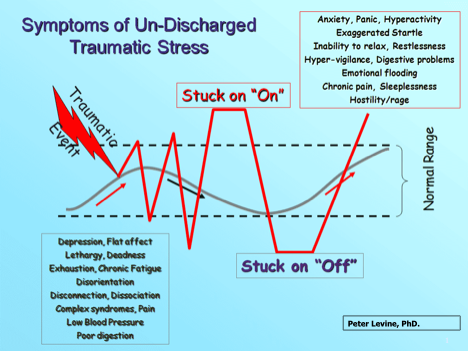
This model applies to autistic people, too. Research suggests they may experience more severe PTSD symptoms than non-autistic people (Quinton et al., 2024) and may interpret traumatic experiences differently (Prosser et al., 2026).
Prosser and colleagues found that autistic participants reported significantly greater PTSD symptom severity and more negative post-traumatic appraisals, particularly those related to alienation, shame, and fear. These appraisals statistically mediated the association between autism and PTSD symptom severity. This highlights the potential importance of how traumatic experiences are interpreted and integrated into one’s sense of self.
Dysregulation Without a Traumatic Event
Although this chart is traditionally used to illustrate responses to trauma, a traumatic event is not necessary for someone to experience hyperarousal (“stuck on”) or hypoarousal (“stuck off”).
For autistic people, everyday sensory experiences can contribute to nervous system overwhelm. Green et al. (2015) found heightened activation in the amygdala and sensory cortices of autistic youth in response to mildly aversive sensory stimuli. They also found reduced habituation among those with sensory overresponsivity.
Habituation is the process through which our nervous system gradually reduces its response to repeated stimuli. For some autistic people, sensory information that others eventually tune out may continue to demand their attention.
Research on resting-state arousal has also found differences in autonomic nervous system activity among autistic people, including patterns of both hyperarousal and hypoarousal (Arora et al., 2021).
Overlapping conversations, uncomfortable clothing, unexpected touch, or prolonged environmental noise may all contribute to dysregulation, even without a traumatic event.
From a neurodiversity-affirming perspective, it is important to distinguish between trauma-related nervous system responses and a person’s inherent sensory processing differences.
Not all dysregulation is rooted in trauma, and not all sensory sensitivity needs to be treated.
Sometimes what a person needs is not trauma reprocessing, but sensory accommodations, rest, environmental changes, or a better understanding of their own nervous system.
EMDR vs. Brainspotting
Before I explain why I tend to prefer Brainspotting with autistic clients, here is a quick guide to how the two modalities differ.
Eye Movement Desensitization and Reprocessing (EMDR)
Uses alternating bilateral stimulation, such as side-to-side eye movements, handheld tactile buzzers, or self-tapping.
Follows a structured protocol, with verbal prompts typically offered after each set of bilateral stimulation.
Often targets specific memories and associated beliefs.
Identifies negative cognitions (negative beliefs about oneself) and desired positive cognitions.
Typically involves periodic subjective distress ratings.
Offers predictability that may appeal to some autistic adults, although certain assessment questions may be challenging for people with alexithymia.
Uses repetitive stimulation that may feel regulating for some people and overstimulating for others.
Has an established research base supporting its effectiveness in treating PTSD.
Brainspotting
Uses a relatively fixed visual position and may incorporate bilateral auditory or tactile stimulation, such as bilateral music or handheld buzzers.
Offers a flexible, process-oriented approach that can involve minimal verbal communication.
Can begin with a sensation, emotion, memory, or broader issue.
Can explore negative beliefs about oneself without necessarily requiring them to be identified before processing begins.
Places less emphasis on standardized ratings during processing, although distress ratings may be collected at the beginning and end to track progress.
Reduces verbal demands, which may help people with alexithymia and some with demand-sensitive profiles, including those who identify with PDA (Pathological Demand Avoidance or Persistent Drive for Autonomy).
Uses sustained visual attention that may feel regulating for some people and uncomfortable for others.
Is a newer modality with preliminary evidence supporting its use in trauma treatment, though its research base is considerably smaller than EMDR’s.
Where I Stand
I acknowledge that I may have some bias toward Brainspotting. I am trained in both modalities, but I am a certified Brainspotting practitioner and have more clinical experience using it.
With autistic clients, I tend to prefer Brainspotting. However, I introduce both modalities and give clients the opportunity to explore which feels like a better fit. Among my clients who have experienced both, most have expressed a preference for Brainspotting.
Here are some reasons I believe this may be the case.
Alexithymia and Interoception
Some autistic people have difficulty identifying emotions, interpreting bodily sensations, or translating internal experiences into language. Alexithymia refers to difficulty identifying and describing emotions, while interoception is our ability to perceive and interpret internal bodily signals.
Although EMDR’s structure can be beneficial, its assessment phase typically asks clients to identify several components of a distressing experience, including:
A distressing image or memory
A negative belief about oneself
A desired positive belief
An associated emotion
A bodily sensation
A subjective rating of distress
During EMDR processing, the client is also periodically asked questions such as, “What do you notice?” For someone with alexithymia or differences in interoceptive awareness, identifying and communicating these experiences may require considerable cognitive effort.
Similar information can be explored in Brainspotting, but the clinician does not necessarily need every component identified or verbalized before processing can begin.
A skilled Brainspotting clinician can attend to subtle changes in a client’s physiological responses, facial expressions, breathing, and other nonverbal cues without asking the client to continuously report what they are experiencing. These observations can inform therapeutic attunement, although they do not provide definitive knowledge of what a client is processing internally.
There is something meaningful about allowing a person to have an emotional experience without immediately requiring them to explain it.
Not having the words for an experience does not mean that the experience is not being processed.
Masking and the Pressure to Perform in Therapy
Brainspotting’s open-ended approach may also reduce the likelihood of a client wondering:
“Am I identifying the correct emotion?”
“What does my therapist expect me to say?”
“Am I doing this correctly?”
Many autistic people have spent years, if not decades, monitoring their behavior, interpreting social expectations, and trying to determine what others expect from them. These patterns of masking can show up in the therapy room.
This can happen in Brainspotting, too, but one phrase commonly used in the modality speaks directly to that pressure:
“Let your brain go wherever it goes. There is no right or wrong.”
EMDR also allows associations to emerge naturally during processing. However, its more structured protocol, periodic check-ins, and returns to the original target may make some clients feel more pressure to stay on track or provide a response.
In Brainspotting, a client may spend ten minutes or longer in silence, letting their mind go wherever it goes, without being prompted to share what they are experiencing. Some clients are talkers, and that is okay, too. Brainspotting requires neither silence nor continuous conversation; it allows flexibility for both.
For some autistic people, having a space where they do not feel obligated to explain themselves, provide an answer, or organize their inner experiences for another person can be particularly meaningful.
Of course, others may find the lack of structure uncomfortable and prefer the predictability of EMDR. This is another reason client autonomy is so important when choosing a modality.
Autobiographical Memory
Trauma does not have to be remembered perfectly for its effects to be experienced.
Traumatic experiences involve multiple brain systems, including those associated with memory, emotional learning, threat detection, and nervous system activation. Past experiences we cannot consciously recall can also influence our physiological and emotional responses. Early adverse experiences, for example, may shape later stress responses and emotional functioning even without explicit autobiographical memory of them.
I have worked with clients who struggle to recall specific details of an experience, even one from just the other day. I particularly notice this among my AuDHD clients (those who are both autistic and ADHD).
Research has also identified differences in how autistic people retrieve specific personal experiences. A systematic review by Munawar et al. (2024) found differences in autobiographical memory specificity and in the retrieval of personal episodic memories.
A person may know that something happened, understand its impact, and feel distress about it without being able to recall the details.
And not every autistic person seeking trauma therapy can identify a particular event that explains their distress. Some may have experienced years of sensory overwhelm, masking, rejection, misunderstanding, or social invalidation. Rather than one specific memory, they may carry a broader sense of shame, alienation, or emotional exhaustion.
Brainspotting can offer flexibility in working with these broader experiences without necessarily requiring a specific memory as a starting point. Some EMDR clinicians have also developed adaptive ways to address cumulative adversity, current triggers, and anticipated future distress rather than exclusively targeting a single past event.
Again, the accessibility of either modality can depend significantly on the clinician’s understanding of neurodivergence and willingness to adapt.
What Does the Research Actually Say?
At the time of writing, I have not found robust autism specific outcome research on Brainspotting, or any studies directly comparing Brainspotting and EMDR in autistic populations. Much of what you will currently find is anecdotal evidence from clinicians and clients.
That includes my own. Many of my autistic clients who have tried both modalities have preferred Brainspotting, but these observations do not establish that it is more effective than EMDR.
Brainspotting is newer, and research can move at a snail’s pace. I would be particularly interested in future research on how it interacts with autistic sensory processing, attentional styles, alexithymia, interoception, and autobiographical memory. Based on my clinical experience, I believe it has the potential to be a valuable trauma-processing modality for this population.
EMDR, by contrast, has already been studied with autistic people. Lobregt-van Buuren et al. (2019) found reductions in PTSD symptoms and psychological distress among autistic adults following EMDR treatment. Although the study was small and not randomized, its findings were encouraging.
Fisher et al. (2023) explored how EMDR therapists adapt their work with autistic people, including changes to communication, preparation, bilateral stimulation, and the overall structure of treatment. The study did not establish the effectiveness of these individual adaptations, but it highlights the importance of tailoring trauma therapy to autistic clients’ needs.
At this time, EMDR has a considerably stronger empirical foundation for PTSD treatment. Whether Brainspotting offers particular advantages for autistic people remains an important question for future research.
My Final Thoughts
I have made a case for why Brainspotting could be a better fit for some autistic people, but this is not to say that EMDR does not work. I believe an EMDR therapist who is neurodiversity affirming and knowledgeable about autism can do excellent trauma work with autistic clients. I would say the same about a Brainspotting therapist.
If you are autistic, I encourage you to work with a trauma therapist who understands your neurotype and how it may shape your experience of therapy. EMDR may also be more accessible through insurance-based practices, given its established research base and wider availability. If Brainspotting is not accessible to you, I certainly encourage exploring EMDR with a qualified, neurodiversity-affirming clinician.
Both modalities continue to evolve. In Brainspotting, for example, I have noticed a growing emphasis in recent years on resourcing: approaches that help clients access experiences of grounding, stability, and regulation. Resourcing and preparation are also important components of EMDR.
Whichever modality you choose, I encourage you to ask yourself three questions:
Do I have a good relationship with this therapist? Do I feel safe, understood, and comfortable being myself?
Is this therapist neurodiversity-affirming, and do they understand my neurotype?
Is this therapist adequately trained in the modality they are using?
The modality matters, and so does your relationship with your therapist and their ability to adapt the process to your needs.
Ultimately, I believe neurodiversity-affirming trauma therapy should not require you to change the way your brain works in order to participate.
Therapy should accommodate the way your brain works, rather than expecting your brain to accommodate therapy.
References
Arora, I., Bellato, A., Ropar, D., Hollis, C., & Groom, M. J. (2021). Is autonomic function during resting-state atypical in autism: A systematic review of evidence. Neuroscience and Biobehavioral Reviews, 125, 417–441. https://doi.org/10.1016/j.neubiorev.2021.02.041
Fisher, N., van Diest, C., Leoni, M., & Spain, D. (2023). Using EMDR with autistic individuals: A Delphi survey with EMDR therapists. Autism, 27(1), 43–53. https://doi.org/10.1177/13623613221080254
Green, S. A., Hernandez, L., Tottenham, N., Krasileva, K., Bookheimer, S. Y., & Dapretto, M. (2015). Neurobiology of sensory overresponsivity in youth with autism spectrum disorders. JAMA Psychiatry, 72(8), 778–786. https://doi.org/10.1001/jamapsychiatry.2015.0737
Lobregt-van Buuren, E., Sizoo, B., Mevissen, L., & de Jongh, A. (2019). Eye movement desensitization and reprocessing (EMDR) therapy as a feasible and potential effective treatment for adults with autism spectrum disorder (ASD) and a history of adverse events. Journal of Autism and Developmental Disorders, 49(1), 151–164. https://doi.org/10.1007/s10803-018-3687-6
Munawar, K., Nair, V., Roy, M., Javed, S., & Jafari, A. S. (2024). Autobiographical memories in individuals with autism spectrum disorders: A systematic review. Current Psychology, 43(35), 28521–28530.
Prosser, R., Rumball, F., King, D., & Steel, C. (2026). Post-traumatic stress disorder in autistic and non-autistic adults: The impact of appraisals on reactions to traumatic events. Autism, 30(3), 605–625. https://doi.org/10.1177/13623613251403405
Quinton, A. M. G., Ali, D., Danese, A., Happé, F., & Rumball, F. (2024). The assessment and treatment of post-traumatic stress disorder in autistic people: A systematic review. Review Journal of Autism and Developmental Disorders, 13, 110–144. https://doi.org/10.1007/s40489-024-00430-9
